
Essential Oils for a Blocked Nose: What Menthol and Eucalyptus Really Do
Menthol makes breathing feel easier, but research shows it doesn't actually open the nose. Here is what really happens, which oils people use for congestion, and how to use them safely.
When your nose is blocked, a whiff of eucalyptus or menthol feels like instant relief. That relief is real, but it is not quite what most people think. Understanding what is actually happening helps you use these oils well and know when they are not enough.
The menthol paradox
Menthol, the cooling compound in peppermint oil, is the best-studied ingredient here. In the 1990s, the British researcher Ron Eccles and colleagues measured what menthol does in people with a blocked nose from the common cold. Their finding was striking: inhaling menthol did not reduce nasal resistance to airflow, so the nose was no more open on the measuring instruments, but people consistently reported that they could breathe more easily.
The explanation lies in our cold receptors. Menthol activates TRPM8, the same nerve receptor that senses cool air. Because we normally feel cool air flowing through our nose as we breathe, triggering those receptors convinces the brain that air is moving freely. The sensation of breathing improves even when the airway itself has not changed.
That is not a placebo, and it is not useless. Feeling less congested is a big part of feeling better, especially when it helps you fall asleep. But it means menthol is a comfort measure, not a decongestant in the medical sense.
What about eucalyptus and cineole?
Cineole, the main compound in eucalyptus, rosemary and ravintsara oils, has a similar cool, penetrating effect. There is also some clinical research on cineole itself, though not in the way most people use it. A 2004 randomised, placebo-controlled trial published in The Laryngoscope found that people with acute sinusitis taking cineole capsules by mouth improved faster than those on placebo. That was a pharmaceutical-grade, measured oral dose. It does not mean you should swallow essential oils, and it does not tell us how much inhalation helps.
Oils people use for congestion
| Oil | Main compound | What it feels like |
| Peppermint | Menthol | Intensely cool, sharp |
| Eucalyptus radiata or globulus | 1,8-cineole | Cool, penetrating, medicinal |
| Ravintsara | 1,8-cineole | Fresh, softer, slightly sweet |
| Rosemary (cineole type) | 1,8-cineole, camphor | Herbal, clarifying |
| Tea tree | Terpinen-4-ol | Fresh, medicinal |
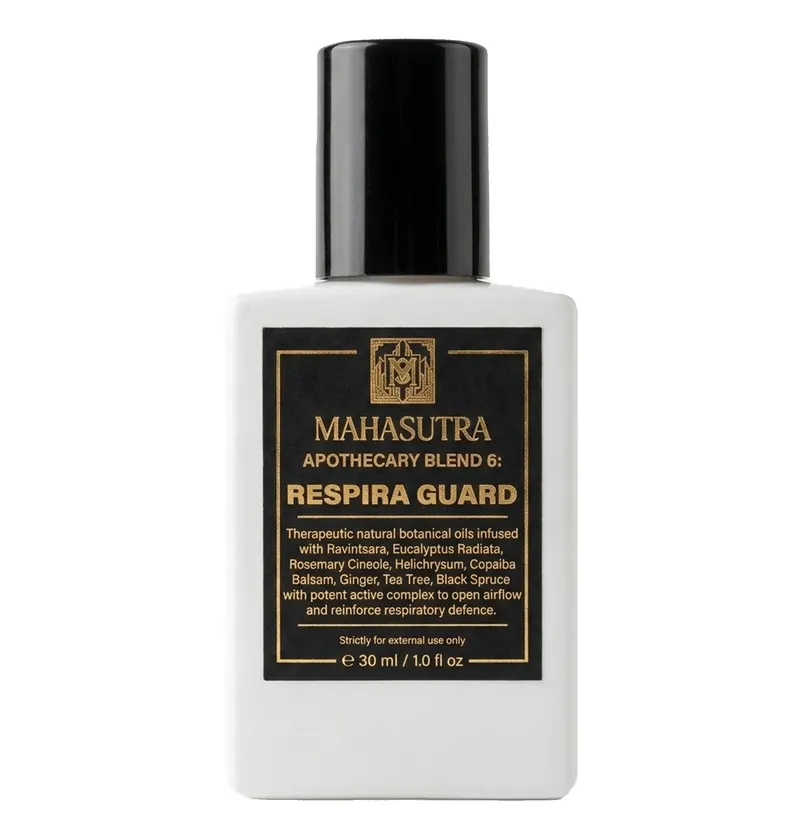
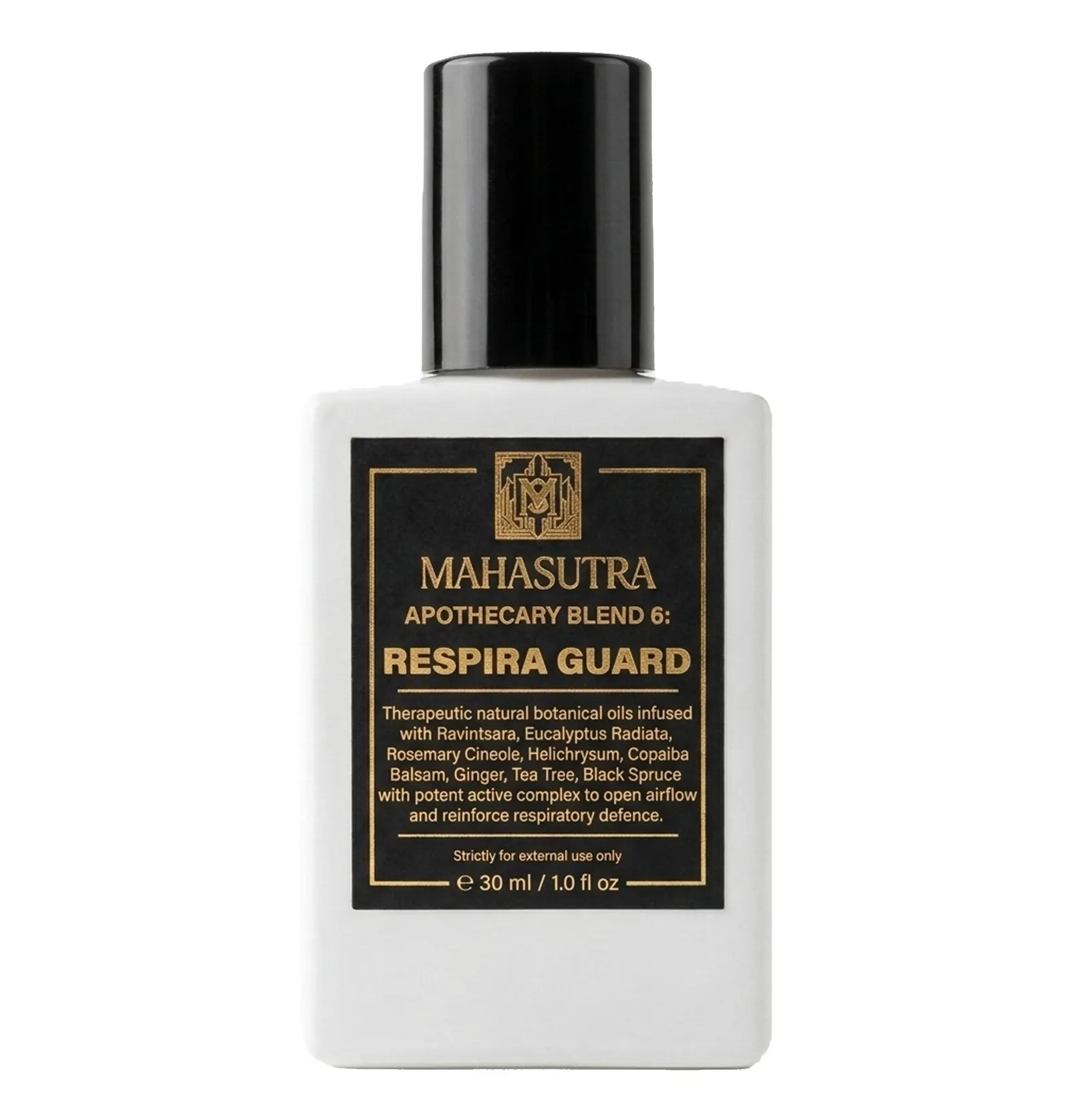
Most breathing blends combine several of these because they layer well: menthol for the immediate cool hit, cineole oils for depth. Our Respira Guard Oil combines eucalyptus radiata, rosemary cineole, peppermint, ravintsara and menthol crystals in a roll-on you can apply to the chest, the back of the neck and the wrists. To understand the difference between two of those ingredients, read ravintsara versus ravensara.
How to use them
- Chest and upper back rub: a pre-diluted roll-on or a 2 to 3 per cent blend in carrier oil. The warmth of your skin carries the vapour up as you breathe.
- Steam: one or two drops in a bowl of hot, not boiling, water. Lean over with eyes closed for a few minutes. Stop if your eyes or skin sting.
- Diffuser: three to five drops in an ultrasonic diffuser in the bedroom for 30 to 60 minutes before sleep, with the door open.
- Tissue or inhaler stick: a single drop on a tissue to sniff during the day.
Important cautions
Do not use peppermint or cineole-rich oils on or near the face of babies and young children, and do not diffuse them close to them. These compounds can cause breathing problems in very young children. Take care with asthma, as strong scents can trigger symptoms. Never put essential oils inside the nose, and never swallow them.
See a doctor if congestion lasts more than ten days, if you have a high fever, severe facial pain, shortness of breath, or symptoms that improve and then get worse. Essential oils can make a cold more comfortable; they do not treat infection.
Common questions
Does menthol unblock your nose?
Studies by Ron Eccles found menthol doesn't reduce measured nasal airflow resistance, but it makes breathing feel easier by activating the nose's cold receptors.
What is the best essential oil for a stuffy nose?
Peppermint (for menthol) and cineole-rich oils such as eucalyptus, ravintsara and rosemary are the most used, often blended in a chest rub.
Can I put essential oil in my nose?
No. Never put essential oils inside the nose. Use a diluted chest rub, a drop on a tissue, steam or a diffuser.
When should I see a doctor for congestion?
If it lasts more than ten days, comes with high fever, severe facial pain or shortness of breath, or improves and then worsens.
This guide is for general information and is not medical advice. Speak to a doctor or pharmacist before using essential oils if you are pregnant, breastfeeding, take regular medication, have epilepsy, asthma or a skin condition, or are using them on a child.
Sources
- Eccles R, Jawad MS, Morris S. The effects of oral administration of (−)-menthol on nasal resistance to airflow and nasal sensation of airflow in subjects suffering from nasal congestion associated with the common cold. Journal of Pharmacy and Pharmacology, 1990;42(9):652–654
- Eccles R. Menthol and related cooling compounds. Journal of Pharmacy and Pharmacology, 1994;46(8):618–630
- Kehrl W, Sonnemann U, Dethlefsen U. Therapy for acute nonpurulent rhinosinusitis with cineole: results of a double-blind, randomized, placebo-controlled trial. The Laryngoscope, 2004;114(4):738–742